SSO User and Group Mapping
When someone signs in with SSO, the IdP sends user attributes, and often group memberships, in the SAML assertion or OIDC claims. Mapping is how you tell Descope what to do with that data: which fields become user profile attributes, which groups become roles on the tenant, and (if you use Fine-Grained Authorization) which groups should create FGA relations for that user.
The same maps apply when:
- The user signs in with SSO (including JIT create/update)
- SCIM syncs groups for that SSO config (RBAC role maps, with FGA maps applied on SSO login)
What You Can Map
| Mapping | What it does |
|---|---|
| User attributes | IdP fields → Descope user fields (email, name, phone, custom attributes) |
| Groups → roles (RBAC) | IdP group names → Descope roles on that tenant |
| Groups → FGA | IdP groups → FGA / ReBAC relations (see below) |
| Default roles | Roles to assign when no RBAC group map matches (common with JIT) |
RBAC and FGA maps don't depend on each other. One IdP group can grant a role, an FGA relation, or both.
SAML IdPs usually send a multi-value groups attribute (or something similar). OIDC doesn't standardize groups, so enable a groups (or custom) claim on the IdP, then set Groups attribute name in Descope to that claim. See OIDC → Group claims for details. Both SAML and OIDC support RBAC and FGA group maps. Protocol notes: Authorization with SSO providers.
Groups to Roles
| IdP group | Descope role |
|---|---|
Engineering | Developer Team |
HR | HR Team |
Sales | Sales Team |
After SSO (and after SCIM group sync, if you use it), a user in Engineering has the Developer Team role on that tenant.
Configure these maps, along with Default roles, under tenant → Authentication Methods → Roles & Groups in the Console. The same maps apply whether the tenant uses SAML or OIDC, and they are preserved if you switch the tenant's SSO method.
By default, Descope adds a role resolved this way to whatever roles the user already has on the tenant — manually assigned roles are left alone. To make the mapping replace the user's existing tenant roles on every login or sync instead of adding to them, turn on Override roles in Project-Level SSO Settings.
Groups to FGA Relations
If you already use FGA (Descope's ReBAC / ABAC system), you can map IdP groups the same way you map them to roles, except the result is a relation instead of a role.
Example: a user in the IdP's Engineering group signs in, and Descope creates a relation like "this user is a member of the engineering team," using whatever schema you've defined for the project. From then on, your app can check that relation the same way it would for any other FGA tuple you created by hand.
You need a schema on the project before this works. If there isn't one, login fails with SchemaDoesNotExist because there's nothing for the mapping to attach to. Start with Defining a schema and implementing it.
This is separate from group → role mapping. You can use one, the other, or both for the same group.
What A Mapping Looks Like
In FGA terms, a relation says: this user has this relation to this resource, under a type (namespace) from your schema.
An SSO FGA map stores everything except the user. Descope fills in the user at login. For each IdP group name, you list one or more entries with:
| Field | Meaning | Where it comes from |
|---|---|---|
| Namespace | The schema type (e.g. team, doc) | Your FGA schema |
| Relation definition | The relation name on that type (e.g. member, editor) | Same schema |
| Resource | The specific object ID (e.g. engineering, handbook) | Whatever resource IDs you use when creating relations |
You configure those maps in the tenant's Roles & Groups tab, alongside the RBAC group maps and default roles, and they apply to both SAML and OIDC. In the Management API they are the fgaMappings field on the SAML and OIDC tenant SSO settings (see the Management tenants SSO API). In the Console and Management API you'll see FGA mappings. Some backend events still say ReBAC groups mappings (rebacGroupsMappings), which is the same feature.
So if you map IdP group Engineering → namespace team, relation member, resource engineering, then on login Descope creates the same kind of relation you'd get from calling Create Relations with that user as the target.
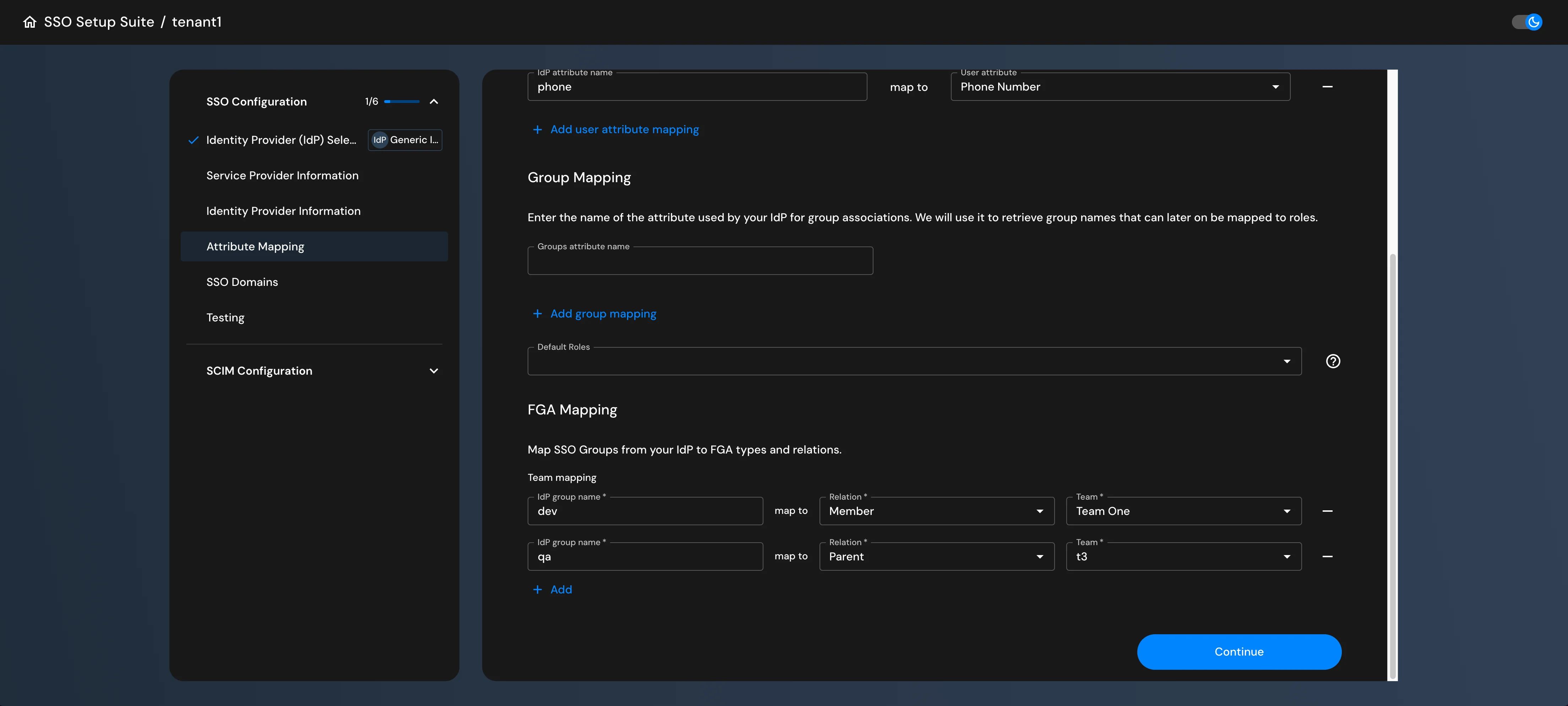
If your resource IDs are opaque (a database key, a folder ID) rather than something readable, the resource picker shows the raw ID by default.
Set a resource display name for that resource (its resourceId and resourceType, the same values as Resource and Namespace in the table above) and the Console mapping screen shows the display name instead.
As shown below, "dev" resolves to a display name ("Team One"); "qa" still shows its raw resource ID ("t3").
Default Relations (Optional)
You can also set a fallback list, defaultReBACRelations, with the same shape (namespace / relation / resource). Descope only uses it when the tenant has no group-specific FGA maps at all. On that path, if a resource is set to {{tenantID}}, Descope replaces it with the real tenant ID at login.
For SAML tenants, configFGATenantIDResourcePrefix and configFGATenantIDResourceSuffix on that tenant's SSO settings control what {{tenantID}} expands to: the resolved resource is prefix + tenantID + suffix. These two fields aren't available on OIDC settings.
How to Set Up FGA Group Mapping
- Create (or confirm) an FGA schema for the project.
- Configure SSO for the tenant (SAML or OIDC).
- Add FGA group maps for that tenant:
- Console: tenant → Authentication Methods → Roles & Groups → FGA Group Mapping.
- API: set
fgaMappingswhen you call the SAML/OIDC tenant SSO settings endpoints.
- Optionally set
defaultReBACRelationsif you want the fallback described above. - Sign in with a test user and check the relation (or inspect it in the Console).
Example
| IdP group | Namespace | Relation | Resource |
|---|---|---|---|
Engineering | team | member | engineering |
Doc Editors | doc | editor | handbook |
SSO → FGA
How an IdP group becomes an FGA relation
IdP groups
Engineering
Doc Editors
maps to
FGA mapping
team · member · engineering
doc · editor · handbook
creates on login
FGA relations
Alice → member of team:engineering
Alice → editor of doc:handbook
Each IdP group name points at a template from your FGA schema (namespace + relation + resource). At SSO login, Descope fills in the user and creates the relation — same shape as a tuple you'd write by hand.
After SSO, Alice has a member relation to team / engineering (and an editor relation on doc / handbook if she's also in Doc Editors). Your app checks those the same way as any other FGA relation.
SSO Setup Suite
Your customer's admin can set attribute and group maps (including FGA, when you've enabled it for the suite) in the Setup Suite, then run the connection test. See Setup Suite attribute mapping.
Management SDK / API
Automate maps with Configure SSO SDKs or the Management tenants SSO API. For FGA, use the fgaMappings field on the SAML/OIDC settings payload.
from descope import (
    SSOSAMLSettings,
    FGAGroupMapping,
    FGAGroupMappingRelation,
)

descope_client.mgmt.sso.configure_saml_settings(
    tenant_id="tenant-id",
    settings=SSOSAMLSettings(
        idp_url="https://idp.example.com/saml",
        idp_entity_id="my-entity-id",
        idp_cert="<certificate>",
        fga_mappings={
            "Engineering": FGAGroupMapping(
                relations=[
                    FGAGroupMappingRelation(
                        namespace="team",
                        relation_definition="member",
                        resource="engineering",
                    ),
                ],
            ),
        },
        # Optional, SAML only: customize what the `{{tenantID}}` placeholder resolves to
        config_fga_tenant_id_resource_prefix="org_",
        config_fga_tenant_id_resource_suffix="",
    ),
    redirect_url="https://your.domain.com",
)
SSOOIDCSettings and SSOSAMLSettingsByMetadata accept the same fga_mappings field; only the SAML variants also take config_fga_tenant_id_resource_prefix / config_fga_tenant_id_resource_suffix.
Multiple IdPs on One Tenant
Each SSO profile has its own maps. Configure them per ssoId. See Multiple SSO providers.
IdP-Side Checklist
- Send the attribute and group names Descope expects (they have to match what you configured).
- Entra ID: prefer stable group IDs over display names if groups get renamed often. See SSO troubleshooting.
- Okta: make sure users/groups are assigned to the app. Assignments versus Push Groups is a common mix-up on that same page.
Verify and Troubleshoot
- Sign in with a known test user.
- Check the login event in Audits (SSO audit fields).
- For RBAC: confirm the user's roles on the tenant match the IdP groups you expected.
- For FGA: check the relations (or look them up in the Console).
- If groups never show up, check IdP app assignment and the Groups attribute name on the SSO config.
| Code / error | Usually means |
|---|---|
SchemaDoesNotExist | No FGA schema on the project; define one before using FGA maps |
E062016 | Failed to update FGA / ReBAC maps from SSO groups |
E062028 | Groups is mandatory, but the IdP sent no group values during an SSO Setup Suite connection test (requires JIT provisioning enabled) |
E113201 | Mappable FGA helpers / Setup Suite pickers hit invalid SAML settings |
More: SSO troubleshooting.
Related
- JIT provisioning
- SCIM
- ReBAC overview · Define a schema · Create relations
- Authorization with SSO providers
- SSO troubleshooting